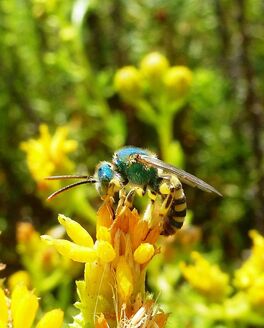
Welcome to the Hung pollinator lab at the University of Oklahoma! We seek to understand the impacts of environmental change on plant-pollinator mutualisms and to quantify the consequences of such impacts on biodiversity conservation and ecosystem function. To that end, we apply techniques from various disciplines of biology to our studies in both natural and human-modified ecosystems. Currently, research topics at the forefront of the lab include impacts of climate change on pollinator and plant ecology and evolution, pollinator conservation in the Great Plains, ecosystem functionality of restored habitats, and refining techniques for effective monitoring of pollinator populations.
As a member of the Oklahoma Biological Survey and the Oklahoma Natural Heritage Inventory, we are also working to construct an inventory and distribution map of pollinator taxa within the state of Oklahoma, starting with native bees.
As a member of the Oklahoma Biological Survey and the Oklahoma Natural Heritage Inventory, we are also working to construct an inventory and distribution map of pollinator taxa within the state of Oklahoma, starting with native bees.
Lab News
05/2024
Izzy Encapera presented her project on bumble bee pollen use at the First Year Research Experience poster symposium! Great job Izzy, and big kudos to Sam O'Dell for being a fantastic graduate student mentor for Izzy!
And, welcome to the lab, Dr. Justin Bain! Justin is joining us from Northwestern University and the Chicago Botanic Garden, where he studied with Dr. Paul CaraDonna. He will be studying pollinator nutritional ecology in our lab over the next couple of years. Stay tuned on this new venture for our lab!
04/2024
Our very own Lauren Rosenfelt is featured in the Spring 2024 issue of Art Focus! Congratulations and great work, Lauren!
And, our study led by Dr. Nico Vereecken is published in Systematic Entomology! This is an opinion piece on why one should not eschew scientific (binomial) names when referring to species, even when common names become more widely used as those species gain wider recognition beyond academic circles. It also features one of the meme-iest graphical abstracts we've ever seen...
01/2024
Welcome to the lab, Izzy Encapera! Izzy is part of the Honors College's First Year Research Experience program, and will be contributing to various pollinator-related projects in the lab.
09/2023
Our study co-led with Dr. Michael Orr, reporting the first mainland record of the stunning Anthophora urbana clementina (hitherto endemic to San Clemente Island, CA), is published in Apidologie! Take-home message: insects can not only invade islands from the mainland, but vice versa too, and we may have a much better chance of detecting such incursions by forging collaborations between community scientists and professional biologists. It takes a village to respond to the threat of species invasions!
Also, our study from my postdoc at U of Toronto with Dr. James Thomson is published open-access in Ecological Applications! Take-home message: pollination is more than just single-visit pollen deposition and visitation frequency: pollinator movement and pollen carryover can be just as important!
08/2023 - Lots going on this month!
Welcome to the lab, Ben Turnley and Jackson Wingert! Ben will be starting his PhD and Jackson his MSc in our lab. We don't yet know what they'll be working on but it's going to be good!
Also, our study led by colleague Dr. Nicolas Leclercq from the Vereecken Lab, who organized a truly global team of pollination biologists to examine apple-visiting bees around the world, is published in Science of the Total Environment! Take-home message: apple-visiting bees unsurprisingly varied across the six continents, BUT they all shared similar evolutionary history and functional traits, suggesting some level of ecological filtering imposed by this cropping system across diverse biomes with distinct geological pasts. Open, herbaceous habitat pretty consistently enhanced wild bee visitation to apple crops, so we can do better for our apple bees (and likely, apple growers and apple eaters) all over the world by protecting natural habitat near orchards.
And, our study led by my fellow UC San Diego alum, Dr. Pierre Lau (now at USDA), synthesizing the state of knowledge regarding the nutritional landscape in agroecosystems from the bees' perspective, is published in Annals of the Entomological Society of America! Take-home message: even vast expanses of cultivated croplands present opportunities for various bee species to fulfill their nutritional needs--but we need to do a better job of understanding what those needs are and how they vary across bee species and landscape contexts, so that we can make the best-informed decisions to improve agricultural practices for both our managed and wild bees.
06/2023
Welcome to the lab, Izzy Gonzales! Izzy will be a field technician assisting in surveying bumble bees and correlates of their occurrence in natural areas throughout our state as part of our ODWC-funded project.
05/2023
Welcome to the lab, Jayden Thomas! Jayden, along with lab veteran Israel Lugo, will take on an NSF REU sponsored by the Mike Kaspari Lab to investigate the arthropod herbivore / predator axis of ecosystem multifunctionality in Lauren's MS thesis.
04/2023
Lauren Rosenfelt was awarded THREE scholarships - the Presidential International Travel Fellowship, the Lois Pfiester Scholarship, and the Kenneth & Joye Harwell Scholarship - to attend a study-abroad course in Oaxaca, Mexico! Congratulations, Lauren!
02/2023
Our study led by colleague Dr. Paige Chesshire, analyzing sampling completeness of native bees in the USA, is published in Ecography! Take-home message: even if we digitize millions more bee specimens in museums around the country, we still lack information on the majority of the bee community in most places around the USA. Time to fund more inventorying and monitoring work!!
12/2022
Israel Lugo was awarded a research fellowship by the Office of Undergraduate Research and Creative Activity to conduct his ENST research project! Congratulations Israel!
11/2022
Welcome to the lab, Israel Lugo! Israel's Environmental Studies Independent Research project will follow up on Tori's work on blooming resources available to pollinators in the early spring, with a special focus on butterfly and moths.
Also, our opinion piece led by colleagues Drs. Corey Callaghan and Thomas Mesaglio, on why YOU should contribute to iNaturalist as an identifier, is published in PLOS Biology! Take-home message: if you have time to spare to identify observations on iNaturalist, please do! Your identifications are likely to contribute more to scientific research and science literacy than you think!
10/2022
Brooke Haden was awarded an Undergraduate Research Opportunities Program research grant by the Honors College to conduct her honors thesis research! Congratulations Brooke!
09/2022
Mary collected the rare and elusive Cemolobus ipomoeae longhorn bee at one of our study sites--a new state record and one of the westernmost sightings of this species, and the Oklahoma Department of Wildlife Conservation wrote a press piece about this great discovery! Congratulations Mary!
08/2022
Welcome to the lab, Sam O'Dell! Sam's PhD research will investigate plant-pollinator interactions in various ecosystems in Oklahoma.
Also welcome again to Brooke Haden! Brooke has been volunteering at the lab and has returned to us to pursue a senior honors thesis! Brooke will investigate how mowing of Symphyotrichum asters in urban lawns influences the timing and quantity of flower production for late-fall pollinators.
07/2022
Our study led by my fellow Holway Lab grad student Annika Nabors, investigating the attractiveness of a set of common landscaping plants to pollinators in Southern California, is published in Environmental Entomology! Take-home message: native ornamental plants attracted a greater abundance and diversity of native pollinators compared to non-native ornamentals that likewise provide abundant floral resources, but species varied widely overall. So, if you want to support pollinators, use a data-driven approach to select ornamental plants when possible, and when data do not exist, choose natives.
04/2022
Welcome to the lab, Mary Powley! As a field and laboratory technician, Mary will traverse the state surveying bees and other pollinators, liaison with habitat managers, and oversee processing and curation of specimens and data in the lab.
03/2022
Tori Wierzchowski was awarded an Undergraduate Research Opportunities Program research grant by the Honors College to conduct her honors thesis research! Congratulations Tori!
01/2022
Welcome to the lab, Lauren Casillas-Rosenfelt! Lauren's Master's research will investigate the ecosystem multifunctionality of two "human-made" habitats found in urban landscapes--Bermuda grass lawns and pollinator gardens.
10/2021
Welcome to the lab, Tori Wierzchowski! Tori's senior honors thesis research will investigate how early-spring pollinators use ornamental and native blooms in urban landscapes.
Also, our study led by my friend and former lab-mate Dr. Andrew Lybbert, investigating how communities of seeded "pollinator-friendly" plants shifted with time in restored grasslands, is published in Ecological Applications! Take-home message: if you seed reclaimed habitat with wildflower seed mixes and just leave it alone, most of the seeded species will drop out after the first few years, with few seeded species remaining after 10 years. So, design seed mixes with ecological succession in mind, and implement some basic management practices to get as much out of your restoration efforts as possible!
09/2021
Our study led by my fellow Holway Lab grad student Kylie Etter, investigating pollinator-mediated interactions between an island-endemic buckwheat and the non-native fennel, is published in Biological Invasions! Take-home message: fennel acts as a "magnet species" that draws more pollinators to visit nearby buckwheat plants, BUT at the cost of also exporting lots of heterospecific pollen onto buckwheat stigmas - and at distances greater than the magnet effect. So, assessment of fennel's impacts on native plant assemblages should take into consideration pollinator-mediated interactions across multiple spatial scales.
